What is StatefulSet:
StatefulSets are used to manage stateful applications, such as databases or other applications that keep track of their state. By using StatefulSets, a set of pods can be deployed and scaled, ensuring that they are ordered and unique.
Why use StatefulSet:
Since ips are random, we have hostname as a stable way to connect to pods. However, when we deploy any app, the service generally have hostname like this and since pod names are also generated with random characters it would become difficult to track them.
podname.svcname.namespace.svc.cluster.local
In such case when we use statefultset, we would get stable pod name and from which we can identify the sequene of pods created.
Example: For MySQL, if we want to create the first pod as master pod and the next ones as read replicas, we can make mysql-0 pod as master.
Pod Identity and Ordering:
StatefulSet pods have a unique ordinal index (0, 1, 2…). This provides:
- Ordered Startup: Pods start from 0 to N-1.
web-1will not start untilweb-0is “Running and Ready.” - Ordered Termination: When scaling down, pods are deleted in reverse (N-1 down to 0) to ensure data is safely offloaded from “workers” before “masters.”
#sf.yml
apiVersion: apps/v1
kind: StatefulSet
metadata:
 name: web
spec:
 template:
  metadata:
   labels:
    app: web
  spec:
   containers:
   - name: web
     image: quay.io/gauravkumar9130/nginxdemo
 replicas: 3
 selector:
  matchLabels:
   app: web
 serviceName: sfsvc
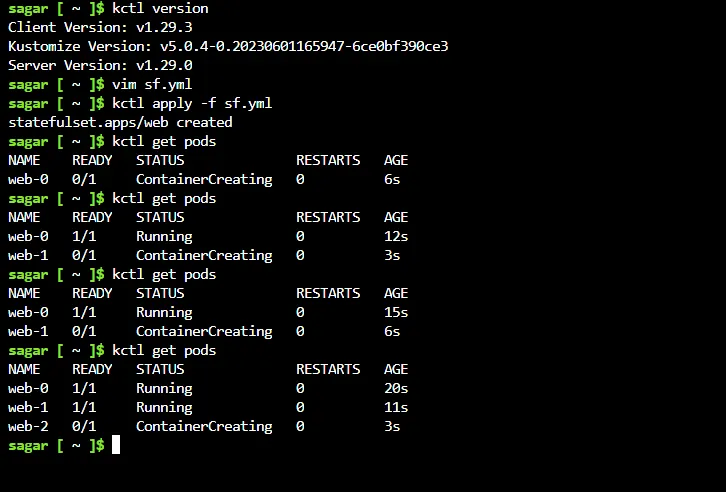
Once we apply we can list the pods and we shall notice sequential pod creation.
Test Query: The DNS entry remains the same even if a pod is deleted. Even if the IP changes, we don’t need to worry. Say we connect our frontend app to the DB in read-mode; it always connects to the specific pod index we want (e.g., web-1).

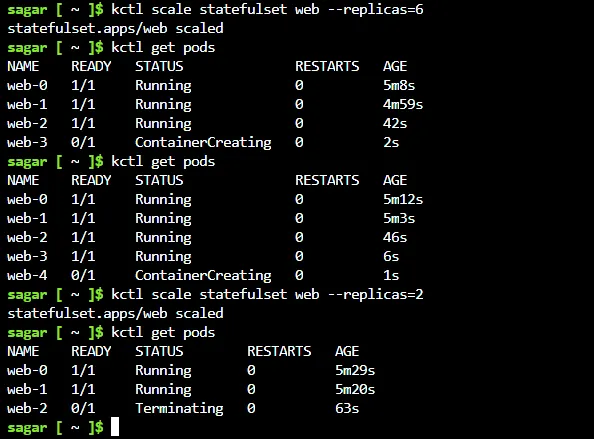
If we scale up and down, the change are also going to be sequential.
Headless Service:
Headless service is a regular Kubernetes service where the spec.clusterIP is explicitly set to “None” and spec.type is set to “ClusterIP”. Instead, SRV records are created for all the named ports of service’s endpoints.
DNS Format: podname.svcname.namespace.svc.cluster.local
apiVersion: v1
kind: Service
metadata:
 name: <HEAD LESS SERVICE NAME this needs to be
matched with the svc name in sf>
spec:
 ports:
 - port: 80
 selector:
  app: web
 clusterIP: None
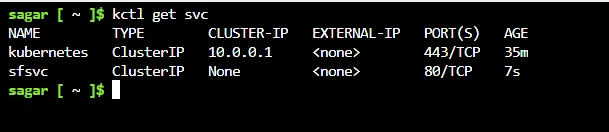
Apply it, and list all the services, we can see clusterIP set to None for headless service.
Using VolumeClaimTemplates:
StatefulSets uses volumeClaimTemplates to provide dedicated storage to each pod. In a Deployment, all pods share the same volume; in a StatefulSet, each pod gets its own.
- Sticky Storage: If
web-0is deleted, the newweb-0will automatically re-attach to the same Persistent Volume. - Safety: PVCs are not deleted when a StatefulSet is deleted, preventing accidental data loss.
Taking an existing storage class:
There are several storage classes in azure, to view them list all the sorage classes.

As we can see there are multiple with different binding mode. lets take managed as it waits for the storage to be claimed first before creating the volumes.
#sf_vol.yml
apiVersion: apps/v1
kind: StatefulSet
metadata:
 name: myweb-statefulset
spec:
 serviceName: myweb-hsvc
 replicas: 5
 selector:
  matchLabels:
   app: web
 template:
  metadata:
   labels:
    app: web
  spec:
   containers:
   - name: web
     image: quay.io/gauravkumar9130/nginxdemo
     volumeMounts:
     - mountPath: /mydata
       name: data-volume
 volumeClaimTemplates:
 - metadata:
    name: data-volume
   spec:
    storageClassName: managed
    accessModes:
     - ReadWriteOnce
    resources:
     requests:
       storage: 500Mi
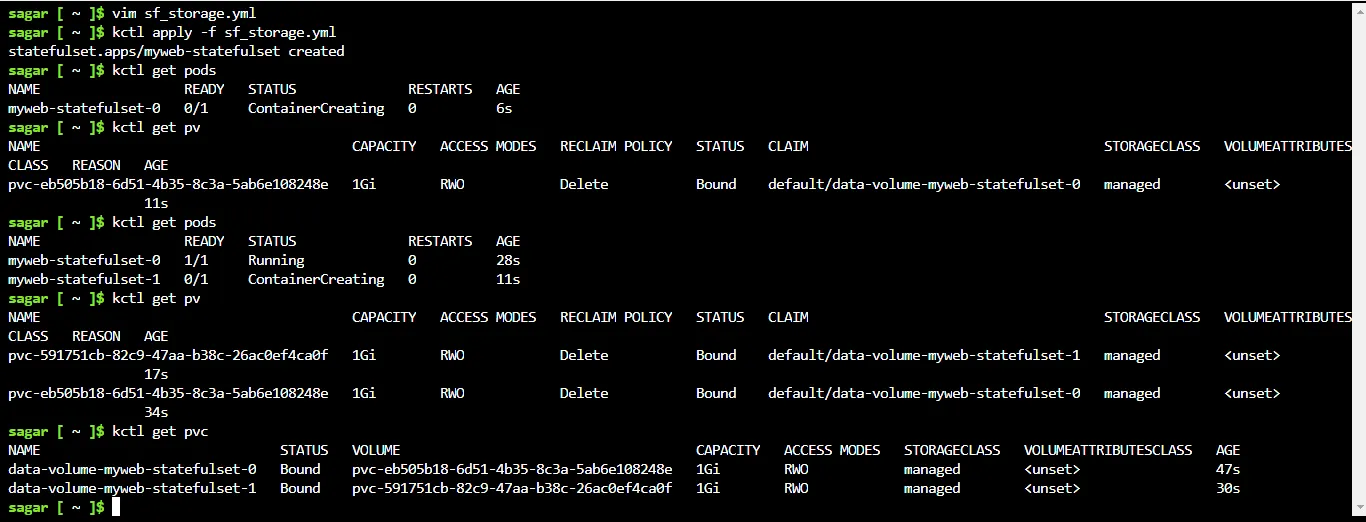
Apply the config and list all the pods and PVCs. You will see that each pod index now has a corresponding volume claim that persists through pod restarts.
Summary:
StatefulSets are the key to running databases and other state-heavy applications on Kubernetes. By providing each pod with a unique ID, a stable hostname, and its own dedicated storage, we ensure that our data stays safe and our cluster remains predictable even during restarts or scaling.